Optimizing Industrial Logistics Chennai: A Guide for Manufacturers
Let’s be blunt: your factory’s output doesn’t mean a thing if you can’t get it off the production line and to its destination efficiently. For many manufacturers in Chennai’s booming industrial corridors, logistics isn’t a strategic advantage—it’s a constant, nagging headache. It’s the missed delivery window that shuts down a partner’s assembly line, the damaged shipment that erodes your profit margin, and the endless phone calls trying to find out where your high-value cargo actually is. The truth is, inefficient industrial logistics Chennai is quietly costing you more than just the freight bill; it’s costing you growth.
I’ve been in this business for over 15 years, and I’ve seen it all. Companies with brilliant products and state-of-the-art factories are often kneecapped by a ‘good enough’ approach to their supply chain. This guide isn’t about abstract theories. It’s a practical, on-the-ground look at what it really takes to streamline your manufacturing logistics and turn transport from a problem into a real competitive edge here in Chennai.
The Hidden Costs of ‘Good Enough’ Factory Goods Transport
Most finance departments see logistics as a line item—a cost to be minimized. That’s a dangerous oversimplification. The real costs of a subpar logistics partner are often hidden, bleeding into other parts of your business. It’s not just about the price per kilometer.
Think about these scenarios. I’ve seen them happen time and time again:
- Production Delays: A truck carrying critical components from your supplier in Ambattur gets stuck for hours due to poor route planning. Your assembly line sits idle, costing you thousands in lost production for every hour of downtime.
- Damaged Goods: Your precisely engineered machinery arrives at the client’s site with damage because the transport provider used the wrong type of truck or lacked the proper securing equipment. Now you’re dealing with returns, repairs, and a very unhappy customer.
- Reputation Damage: You consistently miss delivery deadlines. Your customers start seeing you as unreliable, and eventually, they start looking for a new supplier. This is a slow, silent killer for any B2B manufacturer.
The problem with ‘good enough’ factory goods transport is that it creates uncertainty. When you can’t predict when raw materials will arrive or when finished goods will be delivered, you’re forced to carry extra inventory (hello, holding costs!) and build buffer time into every single plan, making your entire operation less agile.
Key Pillars of Modern Industrial Logistics in Chennai
Moving beyond these basic problems requires a shift in mindset. You need a partner who thinks about your entire process, not just the drive from Point A to Point B. Here are the core components that truly make a difference for industrial logistics in Chennai.
Real-Time Visibility: Beyond a Dot on a Map
In today’s world, not knowing where your shipment is unacceptable. But true visibility is more than a GPS tracker. It’s about predictability. A modern commercial logistics provider should offer a platform where you can see:
- Live Location & ETA: Not just where the truck is, but a constantly updated Estimated Time of Arrival based on real-time traffic and conditions.
- Status Alerts: Automated notifications for key milestones like ‘Left the Warehouse,’ ‘Arrived at Hub,’ and ‘Out for Delivery.’ This stops the endless chain of follow-up calls.
- Digital Proof of Delivery (ePOD): Instant confirmation, complete with signatures and photos, the moment your goods are received.
This level of transparency allows your team to plan proactively instead of reacting to problems. It’s a fundamental shift.
Route Optimization for Chennai’s Unique Traffic
Anyone who has tried to get from Sriperumbudur to the Chennai Port during peak hours knows that Google Maps alone won’t cut it. A professional logistics partner with deep local knowledge understands the city’s unique pulse. They know which routes to avoid at certain times, the unofficial chokepoints, and the best times to move industrial cargo transport through congested areas. This isn’t just about saving fuel; it’s about ensuring reliable transit times, which is the bedrock of any Just-in-Time (JIT) manufacturing strategy.
Specialized Handling for Machinery and Bulk Goods
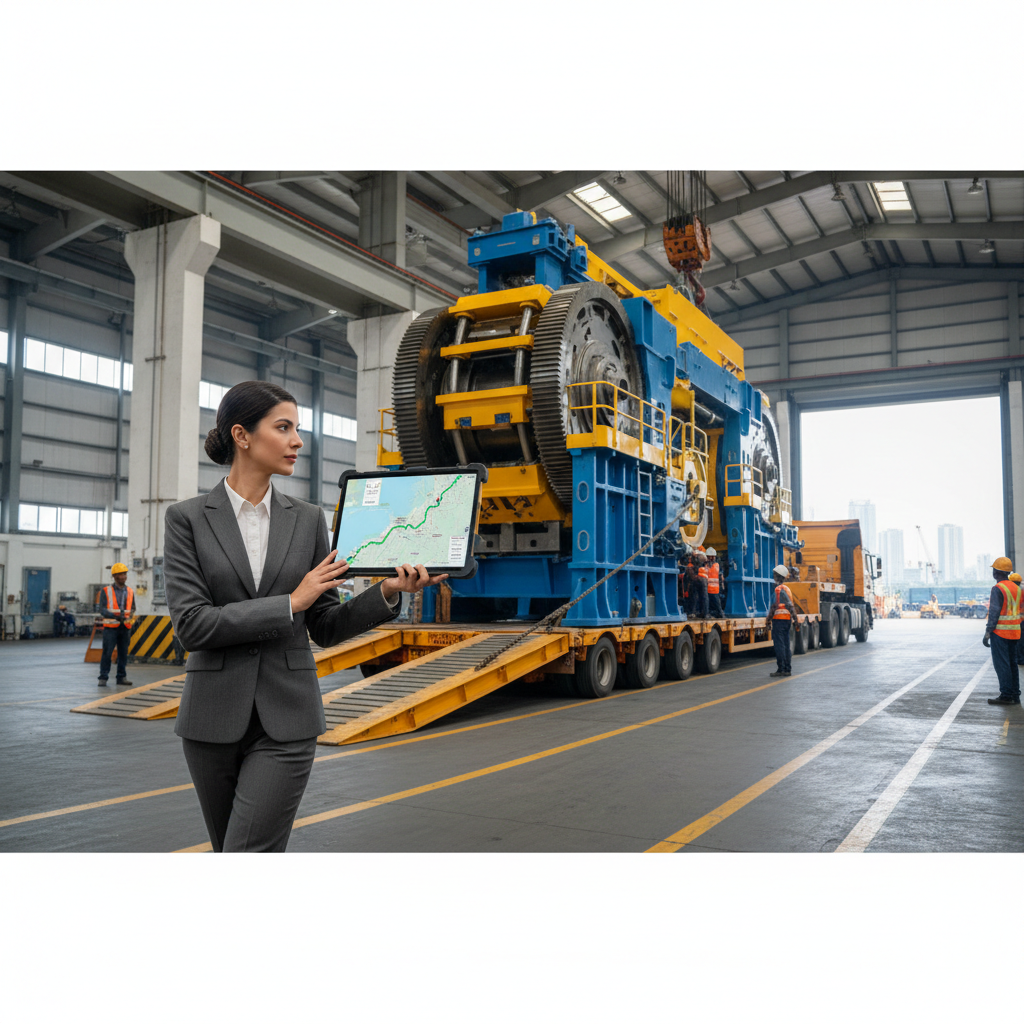
Moving a pallet of consumer goods is one thing. Transporting a 15-ton CNC machine is another entirely. Effective machinery transport in Chennai requires more than just a big truck. It demands:
- The Right Equipment: Access to a fleet of flatbeds, low-bed trailers, and trucks with hydraulic lifts or cranes.
- Trained Manpower: Drivers and handlers who are experienced in loading, securing, and balancing heavy, oversized, or unusually shaped cargo.
- Proper Permits: Navigating the paperwork and permissions required for oversized load (OSL) transport is a job in itself.
The same applies to bulk goods transport, whether it’s raw materials, chemicals, or agricultural products. The risk of spillage, contamination, or damage is high, and you need a provider who has the right protocols in place.

What We See in Practice: Common Mistakes in Manufacturing Logistics
From my vantage point working with dozens of manufacturers, I see the same patterns emerge. These are the most common (and costly) mistakes factories make when it comes to their logistics.
First-Hand Observation: The single biggest mistake is treating logistics as a commodity. A manufacturer in Oragadam was losing nearly 5% of their shipments to minor damages and delays. They were fixated on getting the absolute lowest per-trip rate. After we audited their process, we found that switching to a provider that was 10% more expensive but offered better vehicle quality and real-time tracking actually saved them money by eliminating damage claims and late-delivery penalties. Their total cost of ownership went down, not up.
Mistake 1: Choosing the Cheapest Provider, Not the Best Value
The cheapest quote often comes with hidden costs: older vehicles prone to breakdowns, untrained drivers, no insurance, and zero technology. You pay a low price upfront and pay for it again and again in delays, damages, and headaches. The smart move is to look for value—reliability, safety, and efficiency—not just the lowest number on an invoice.
Mistake 2: A Siloed Approach to Transport
Logistics doesn’t exist in a vacuum. It has to be tightly integrated with your production and warehousing. When your warehouse transport services are disconnected from your factory floor and your outbound shipping, you get chaos. For instance, a truck arrives for pickup, but the goods aren’t ready, or the warehouse team wasn’t notified. The truck waits, and you get hit with detention charges. A holistic approach is essential.
Mistake 3: Neglecting Data and Analytics
Are your shipments consistently late on Tuesdays? Is one particular route always causing damage? Without data, you’re just guessing. A good logistics partner provides you with performance reports. They help you analyze transit times, costs per unit, and on-time delivery rates. This data is gold. It helps you identify inefficiencies and make informed decisions to improve your entire supply chain. You can’t optimize what you don’t measure.
A Framework for Selecting the Right Commercial Logistics Provider
So, how do you find a partner who gets it? Don’t just ask for a price list. Go deeper. Use this framework to vet potential providers and find a true partner for your manufacturing operations.
1. Assess Their Fleet and Operational Capabilities
Don’t be afraid to ask the tough questions. Do they own their fleet or are they just an aggregator? What is the average age of their vehicles? What types of trucks can they provide on short notice? A reliable provider for {{internal_link:full truckload services}} will have a diverse, well-maintained fleet to handle everything from standard pallets to oversized industrial machinery.
2. Evaluate Their Technology Stack
Ask for a demo of their customer portal or Transport Management System (TMS). How easy is it to book a shipment? Can you track your cargo in real time? How are you notified of exceptions or delays? If their answer involves a series of phone calls and WhatsApp messages, they aren’t a modern logistics provider.
3. Verify Their Local Expertise and Network
A national company might look impressive, but do they understand the specifics of operating in Chennai? Ask them about their experience with the industrial belts of Sriperumbudur, Oragadam, and Gummidipoondi. A provider with a strong local presence, like Droptruck, has the ground-level knowledge to navigate local challenges effectively, making them a more reliable {{internal_link:logistics solution for businesses}} in the region.
4. Check for Safety, Compliance, and Insurance
This is non-negotiable. Your cargo is valuable. Your provider must have comprehensive goods-in-transit insurance. Their drivers must be properly vetted and trained, and their vehicles must be compliant with all transport regulations. Ask for proof. A professional and trustworthy partner will provide this information without hesitation.
Frequently Asked Questions about Industrial Logistics in Chennai
-
What’s the main difference between industrial logistics and regular logistics?
Industrial logistics focuses on the B2B movement of raw materials, semi-finished goods, heavy machinery, and bulk cargo, often for manufacturing or construction. It requires specialized equipment and handling, whereas regular (or commercial) logistics often deals with finished consumer goods in smaller, standardized units.
-
How much does industrial cargo transport cost in Chennai?
Costs vary widely based on distance, weight, cargo type, and vehicle required. A short trip with a standard truck might be a few thousand rupees, while specialized machinery transport in Chennai could cost significantly more. It’s best to get a quote based on your specific needs.
-
How do you ensure the safety of our factory goods during transport?
Safety is a multi-step process. It involves using the correct vehicle, professional lashing and securing techniques, trained drivers, real-time tracking to monitor the route, and comprehensive insurance to cover any unforeseen incidents.
-
Can you handle urgent or last-minute industrial shipments?
Yes, a key benefit of working with a tech-enabled provider like Droptruck is the ability to arrange for {{internal_link:on-demand truck booking}}. Our wide network allows us to find and dispatch available vehicles quickly to meet urgent manufacturing deadlines.
-
What industrial areas in and around Chennai do you serve?
We provide comprehensive industrial logistics in Chennai and its surrounding industrial corridors, including Sriperumbudur, Oragadam, Maraimalai Nagar, Gummidipoondi, and Ambattur Industrial Estate, among others.
-
Do you offer dedicated fleet services for large manufacturers?
Absolutely. For manufacturers with consistent, high-volume shipping needs, we offer dedicated fleet solutions. This provides you with guaranteed vehicle availability, trained drivers familiar with your specific requirements, and often, more cost-effective pricing.
Stop Managing Trucks, Start Managing Growth
Your team’s expertise is in manufacturing, not in haggling with transporters or chasing down trucks. Every hour you spend dealing with logistical fires is an hour you’re not spending on innovation, quality control, or business development.
Shifting to a strategic partner for your industrial logistics in Chennai isn’t an expense; it’s an investment in operational stability and scalability. It’s about building a resilient supply chain that supports your growth instead of holding it back.
Ready to see what a proactive, technology-driven logistics partnership can do for your factory? Schedule a free, no-obligation audit of your current factory goods transport process. One of our Chennai-based industrial logistics specialists will help you identify hidden costs and opportunities for improvement.
From an SEO execution perspective, improving industrial logistics Chennai is usually where we see the strongest compounding gains over 3-6 months.
From an SEO execution perspective, improving industrial logistics Chennai is usually where we see the strongest compounding gains over 3-6 months.
From an SEO execution perspective, improving industrial logistics Chennai is usually where we see the strongest compounding gains over 3-6 months.
Frequently Asked Questions
What’s the main difference between industrial logistics and regular logistics?
Industrial logistics focuses on the B2B movement of raw materials, semi-finished goods, heavy machinery, and bulk cargo, often for manufacturing or construction. It requires specialized equipment and handling, whereas regular (or commercial) logistics often deals with finished consumer goods in smaller, standardized units.
How much does industrial cargo transport cost in Chennai?
Costs vary widely based on distance, weight, cargo type, and vehicle required. A short trip with a standard truck might be a few thousand rupees, while specialized machinery transport in Chennai could cost significantly more. It’s best to get a quote based on your specific needs.
How do you ensure the safety of our factory goods during transport?
Safety is a multi-step process. It involves using the correct vehicle, professional lashing and securing techniques, trained drivers, real-time tracking to monitor the route, and comprehensive insurance to cover any unforeseen incidents.
Can you handle urgent or last-minute industrial shipments?
Yes, a key benefit of working with a tech-enabled provider like Droptruck is the ability to arrange for on-demand truck booking. Our wide network allows us to find and dispatch available vehicles quickly to meet urgent manufacturing deadlines.
What industrial areas in and around Chennai do you serve?
We provide comprehensive industrial logistics in Chennai and its surrounding industrial corridors, including Sriperumbudur, Oragadam, Maraimalai Nagar, Gummidipoondi, and Ambattur Industrial Estate, among others.
Do you offer dedicated fleet services for large manufacturers?
Absolutely. For manufacturers with consistent, high-volume shipping needs, we offer dedicated fleet solutions. This provides you with guaranteed vehicle availability, trained drivers familiar with your specific requirements, and often, more cost-effective pricing.